Last updated: October 30, 2026
Key Takeaways
- The real difference is not just size.
- Better image quality matters more than size alone.
- Convenience wins when light travel matters more than picture quality.
- The two overlap, but they solve different problems.
A portable projector vs mini projector choice is mostly about image quality, not just size. Portable projector vs mini projector is the practical question: do you want a better movie picture, or the smallest carryable device? If I had to give the shortest useful answer: pick a portable projector for better movie nights and room-to-room flexibility, and pick a mini projector for light travel, quick sharing, or a tiny desk setup.
A few terms get mixed together here. A portable projector can mean a compact, carry-anywhere unit that still aims for a living-room style image. A mini projector usually means a smaller, lower-output model made for casual viewing. Pico projector is the even smaller niche below that, often pocket-sized and heavily compromised on brightness. Laptop projector is not really a size class at all; it usually means a projector meant to sit near a computer for slides, spreadsheets, or quick media playback.
I write about display gear and home entertainment, so I focus on the specs that actually change the experience: brightness, power source, throw distance, and image quality. In portable projector vs mini projector comparisons, those four specs do most of the work.
Portable projector vs mini projector: the real difference
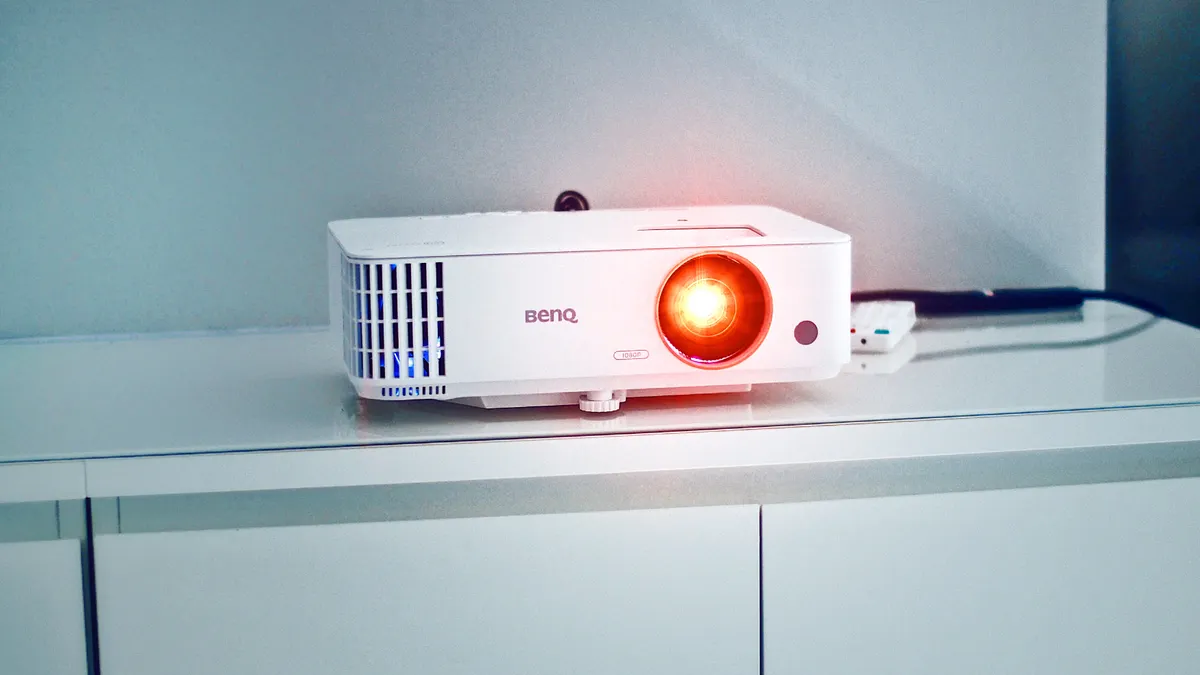
The real difference is not just size. It is the kind of image each one can produce and the setting it is built for. A portable projector usually has a bigger chassis, more cooling space, and a stronger light engine, which gives it a better shot at watchable contrast and usable brightness in real rooms. A mini projector trades that away for easier carrying and simpler setup.
That trade-off shows up fast in the specifications. Many mini projectors are built around lower lumen ratings and smaller speakers, while portable models often add stronger built-in audio, autofocus, keystone correction, and sometimes a battery. Mini units may still be perfectly fine for cartoons in a dark bedroom or a quick clip on a hotel wall, but they are rarely the right pick for a bright family room. Portable models are the ones more likely to stand in for a casual living-room setup.
For buyers comparing portable projector vs mini projector options, the cleanest way to think about it is this: portable describes what the device can do across more situations, while mini describes what it can carry with less effort. Those are not the same thing. A small body does not guarantee a good picture, and a slightly larger body often buys you the brightness headroom that makes the image readable outside a pitch-black room.
For shoppers trying to move from confusion to a decision, the guide to how to choose a portable projector belongs next because it walks through the features that matter after this category split. The choice starts with form factor, but it ends with use case.
Head-to-head: what changes the choice
| Criteria | Portable projector | Mini projector | Winner for this condition |
|---|---|---|---|
| Physical size | Usually larger and harder to pocket | Smaller, easier to toss in a bag | Mini projector for constant carry |
| Brightness potential | Typically higher | Typically lower | Portable projector for real rooms |
| Battery use | More likely to include battery, but not always | More likely to be plug-in only or tiny-battery | Portable projector for unplugged use |
| Image quality | Better odds of sharper, more watchable video | More likely to look soft or dim | Portable projector for movies |
| Travel convenience | Still portable, but less pocketable | Best for light packing | Mini projector for short trips |
| Home theater use | Better fit for casual movie nights | Usually too limited for that role | Portable projector |
| Desk or laptop use | Works, but may be overkill | Often matches simple computer use | Mini projector for quick presentations |
| Heat and fan noise | Often managed better by larger bodies | Can get noisy in cramped shells | Portable projector in quiet rooms |
| Speaker quality | More room for usable audio | Smaller speakers are common | Portable projector |
| Setup flexibility | Often more features like autofocus | Fewer adjustments, fewer extras | Portable projector |
What a portable projector gives you that a mini projector usually doesn’t
A portable projector wins when the goal is a picture people actually want to keep watching. It is the safer choice for a living room, backyard movie night, dorm common room, or anywhere the lights are not fully off. The reason is physical, not marketing: a larger enclosure leaves more room for cooling, optics, and stronger light output.
That extra room usually helps with the things readers notice first. Text looks cleaner on screen. Faces do not collapse into mush as quickly when the room is not perfectly dark. The image holds up better on a wall that is not ideal. A portable model is also more likely to include useful convenience features such as autofocus, keystone correction, and better app support, which cuts down on fiddling before a screening.
The downside is plain: a portable projector is still something you carry, not something you forget you packed. Some models are table-friendly rather than bag-friendly. A battery, if included, adds weight and may be enough only for a film rather than an all-night session. Many owners’ complaints about this class center on fan noise, mediocre built-in apps, and the fact that “portable” still does not mean “small enough to live in a jacket pocket.”
That makes this category wrong for someone who wants the absolute smallest object possible, or for a user who only needs to show slides in a conference room with controlled lighting. It is also the wrong pick if your main priority is price sensitivity and you do not care much about image size or brightness. In those cases, a mini projector does the job with less bulk, as long as expectations stay modest.
Why mini projector models still make sense
A mini projector wins when convenience matters more than cinematic quality. It is the better call for travel bags, bedroom use, children’s rooms, and quick screen sharing where the wall is close and the room is dark. If the plan is to show a phone video, stream a sitcom, or throw up a PowerPoint in a small space, a mini projector can be easier to live with than a larger portable unit.
The main appeal is obvious: smaller footprint, lower weight, and simpler handling. That matters when the device is going into carry-on luggage or a drawer that is already full. A mini unit also tends to fit the “grab it and go” use case better than a more fully featured portable projector. For someone who moves between rooms or needs a backup display for occasional use, that simplicity is valuable.
The drawback is equally obvious once the novelty wears off. A mini projector usually asks for more darkness, more patience, and more compromise. At typical consumer sizes, brightness is the first thing to disappear, then color accuracy, then sharpness at the edges. Built-in speakers can sound thin, and if the unit is meant mainly for casual viewing, it may skip the kind of image processing that keeps motion from looking rough. That is why a mini projector is a poor substitute for a home theater. It can show a movie. It usually cannot stage one.
This is the right pick for someone who knows the screen will be small, the room will be dark, and the content will be casual. It is not the right pick for a buyer trying to replace a television, or for anyone who expects strong daytime performance without curtains.
The honest side-by-side
A portable projector and a mini projector overlap, but they do not compete on the same terms. One is built to stretch beyond “toy” status; the other is built to shrink. That difference shows up in almost every spec that matters.
A portable model is more likely to give you a stable image at a moderate viewing distance, which is why it tends to work better for a couch-and-wall setup. A mini model is more likely to be the one you can bring to a hotel, a friend’s place, or a small office without thinking twice. If the room is already dark and the image does not need to be huge, the mini unit can be good enough. If the room has ambient light or you want movie-night comfort, the portable unit is the better fit.
For a concrete mental model, think in use patterns rather than labels. A laptop projector is often about convenience for work. A pico projector is about extreme portability with obvious trade-offs. A mini projector sits near the bottom of the quality ladder and wins on size. A portable projector sits above that line and tries to preserve a more satisfying picture.
Two authoritative places to sanity-check expectations are the Society of Motion Picture and Television Engineers for display standards language and THX for home-theater ideas around image and sound quality. Those bodies do not pick a winner for you, but they do reinforce the point that display quality is about more than whether a device turns on and throws light.
Which one should you buy for travel, movies, or work?
Choose a portable projector if the trip involves more than a quick slideshow or phone clip. It is the better match for travelers who want a usable movie image in a hotel room, a rental, or a friend’s house, because it is more likely to have the brightness and controls to survive imperfect conditions. Choose a mini projector if your priority is to pack light and you can accept a smaller, dimmer picture in exchange.
For home theater use, portable wins. For casual viewing, mini can be enough. For work, the answer depends on the room: a mini projector is fine for a dim office or a personal desk setup, while a portable projector is better when the audience is larger or the lights are less controlled. Neither belongs in a room where the goal is a bright, all-day display replacement.
One thing that gets missed in generic advice is the power source. A battery changes how useful a portable projector feels, but it does not magically make it better at everything. A battery-powered unit can still be too dim, and a plug-in mini projector can still be the easier choice if the outlet is always nearby. The label is only the starting point.
When to reconsider the whole category
Sometimes the right answer is neither one. If you want to replace a TV in a bright room, a projector of any size may be the wrong tool. If you need a device for outdoor daytime use, the constraints get even tougher. If your main goal is business presentations in lit rooms, a conventional laptop projector or a brighter office-focused model may be more sensible than either a mini or a travel-first portable unit.
There is also a line where “portable” stops being helpful. If the unit is so small that it needs near-darkness and a very short throw to look decent, it may function more like a pico projector than a true portable movie machine. That is fine for its niche, but it is not the same promise. Buyers get into trouble when they expect one tiny box to do cinema, sports, and office work equally well.
A practical rule: if the room matters more than the bag, do not shop by size first. Shop by brightness, placement, and the kind of image you want at 100 inches versus 60 inches. The form factor comes after that, not before it.
Verdict: portable projector or mini projector?
Choose portable projector if you want the better all-around picture, plan to watch movies more than clips, or need one device that can handle travel and casual home theater. Choose mini projector if you mainly want the smallest, lightest option for dark-room viewing, quick sharing, or occasional trips. Neither if you need strong daytime performance, TV replacement, or a presentation tool for bright rooms.
Is a mini projector the same as a portable projector?
No, a mini projector is usually just one smaller subtype of portable projector. The overlap is real, but the terms are not interchangeable. Portable projector describes the broader idea of a carryable unit, while mini projector usually signals a smaller body and more modest output. That distinction matters because the mini label often comes with lower brightness and simpler optics.
Which is better for travel portable or mini projector?
A mini projector is better for light travel, and a portable projector is better if travel includes real movie use. The deciding factor is not the suitcase; it is the room you will use it in. If you need the smallest item and can live with a dimmer image, mini wins. If you want a more watchable picture in hotels or rentals, portable wins.
Can a mini projector replace a tv?
Usually no. A mini projector can fill the role for casual viewing in a dark room, but it usually cannot match a TV for brightness, convenience, or everyday reliability. It needs more control over the room, more setup tolerance, and more acceptance of weaker sound and image quality. If you want a true TV substitute, a mini projector is usually the wrong tool.
Drafted with AI; not yet reviewed by a person.